Non-Toxic Baby Products: What to know
This post may contain affiliate links that I may receive a commission from if you click & buy. In addition, the information on this site is NOT intended to be medical advice. See my full policy for more information.
If you’ve ever stood in the baby aisle wondering “Which of these products are actually safe?”, you’re not alone. The world of “non-toxic baby products” has exploded, and while that can be empowering… it can also feel overwhelming fast. One brand tells you one ingredient is the enemy, another swears their product formula is “clean,” and somewhere in between, you’re just trying to buy lotion without needing a PhD.
Here’s the truth: you don’t need to toss everything you own or obsess over every single ingredient. You do deserve clear, honest information so you can make choices that feel right for your family, without fear, shame, or panic.
The research is pretty clear: reducing certain types of chemical exposures during infancy can be beneficial, but many risks are dose-dependent, exaggerated, or often misunderstood. So my goal isn’t to make you feel like you’re doing everything wrong; it’s to help you understand what matters most, what’s less of a big deal, and where small swaps can make a meaningful difference.
Think of this as a practical, middle-ground guide from one mom to another, backed by reputable sources like the American Academy of Pediatrics (AAP), peer-reviewed studies, and regulatory safety data.
You’re going to walk away feeling confident, not scared. I promise.
This post may contain affiliate links from which I receive a commission if you click or make a purchase. This article is for informational and educational purposes only and is not intended to replace medical advice, diagnosis, or treatment. See my full policy for more information.
Understanding Non-Toxic Baby Products
When you see the phrase “non-toxic,” it’s easy to assume it means zero chemicals, but that’s not actually possible (or necessary). Everything, even water, is a chemical.
What really matters is reducing exposure to ingredients that have been shown in research to irritate the skin, disrupt the endocrine system at high doses, or accumulate in the body over time.
The AAP notes that infants are more vulnerable to environmental exposures because their skin is thinner, their detoxification systems are still developing, and they have a higher surface-area-to-body-weight ratio than adults (AAP, 2018).
But this doesn’t mean every synthetic ingredient is dangerous. Instead, it’s about identifying which exposures are worth minimizing, especially in things your baby uses daily, like lotions, diapers, soaps, and feeding items.
But here’s the part many blogs don’t talk about: dose matters. Not all ingredients labeled “toxic” online are harmful at the low levels found in regulated baby products.
The Centers for Disease Control and Prevention (CDC) emphasizes that toxicity depends on the amount and duration of exposure, not the mere presence of a chemical. This is where a balanced, non-fear-based approach becomes so important.
“Non-toxic” is not a regulated term, so products can label themselves however they want. That’s why understanding the basics empowers you to make choices based on science rather than marketing claims.
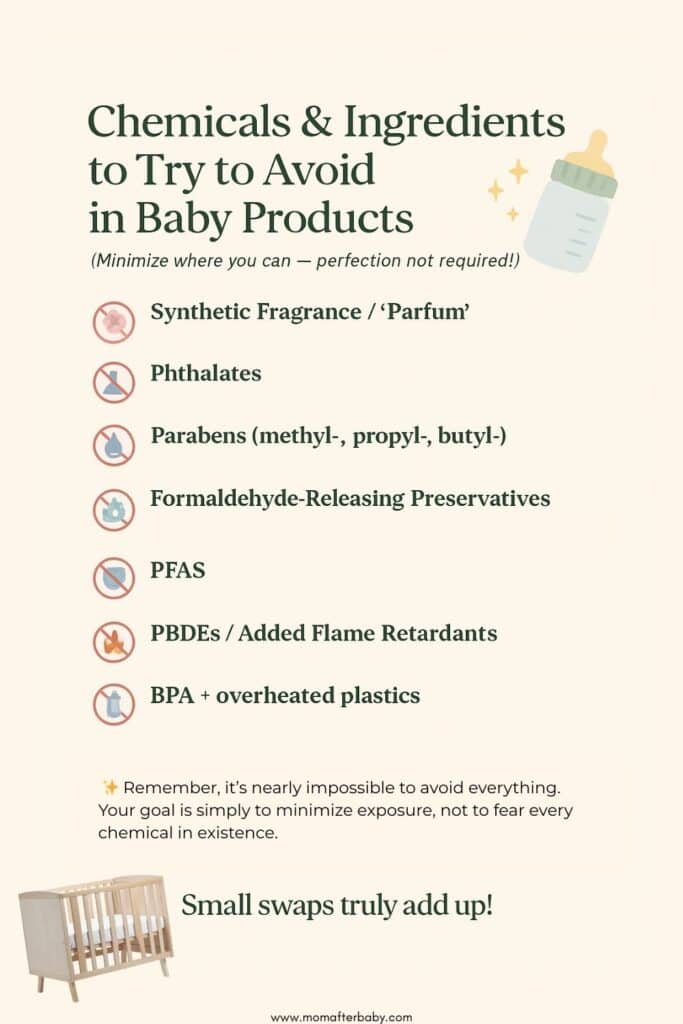
Chemicals and Ingredients to Try to Avoid in Your Baby’s Products
Here’s an important reminder: It is nearly impossible to avoid every single concerning ingredient 100% of the time.
Your goal is not perfection, it’s minimizing exposure where it’s practical and realistic, especially with products your baby uses frequently or that come in direct contact with their skin.
So below is a mom-friendly breakdown of ingredients worth reducing when you can, plus research to help you understand why.
- Fragrance (Synthetic Fragrance & Parfum): Fragrance mixes can contain dozens of undisclosed chemicals, some linked to allergic reactions or respiratory irritation. The AAP specifically recommends reducing fragrance exposure in children when possible.
- Phthalates: Often used to make plastics flexible and help fragrances last longer. Certain phthalates have been associated with endocrine disruption in developmental studies.
- Parabens: These preservatives prevent mold growth but can act as weak endocrine disruptors in excessively high amounts. The FDA states they are generally recognized as safe at low levels but acknowledges that ongoing research is needed and transpiring to provide more information.
- Formaldehyde & Formaldehyde-Releasing Preservatives: Prolonged exposure has been linked to respiratory irritation. The AAP suggests minimizing exposure when possible.
- PFAS (“Forever Chemicals”): Used for waterproofing and stain resistance. Research links PFAS exposure to changes in immune function and developmental outcomes.
- Flame Retardants (PBDEs): There is limited evidence of adverse effects in humans, however, some studies linked negative affects to thyroid function and neurodevelopment.
- BPA & Certain Plasticizers: The FDA banned BPA in baby bottles and sippy cups in 2012 and also in 2013, they banned use of BPA-based epoxy resins as coatings in packaging for infant formula. However, it’s important to know that in some plastics or packaging, they may still be present. While evidence is mixed, reducing exposure in food-contact items is recommended.
Where Avoiding Toxins Matters Most
When you’re deciding where to spend your energy (and your money), it helps to focus on the areas where your baby has the most frequent or long-term contact. These are the swaps that actually move the needle and make a difference, not the ones the internet tries to guilt you into.
Research from the AAP consistently shows that exposure concerns tend to be highest in products that touch three main areas: **your baby’s skin, lungs, and anything that goes in their mouth.**¹⁻²
That’s why the goal isn’t to overhaul everything, it’s simply to prioritize wisely.
Think about it like this: your baby isn’t chewing on your coffee maker or wearing your adult shampoo (thank goodness). But they are snuggled into their mattress for 10–14 hours a day, possibly drinking from baby bottles multiple times a day, and breathing the air in your home 24/7.
So the biggest wins usually come from improving what they sleep on, what they eat from, and the everyday products that go on their skin.
How to Read Labels Without Losing Your Mind
This is the part most moms dread, the endless Googling, deciphering, and second-guessing. But I want to simplify it for you with a few calm, practical guidelines (the same kind of guidelines that helped me as both a first and second time mama).
1. Ignore the marketing terms on the front.
“Natural,” “pure,” and “green” aren’t regulated. Look at the ingredient list instead.
2. Choose fragrance-free whenever possible.
This single change reduces exposure to dozens of undisclosed (and completely unnecessary) chemicals.
3. Look for trusted third-party certifications.
These help cut through the noise. Examples:
- Made Safe Certified – the only human health and ecosystem-focused product certification program.
- GREENGUARD Gold – seeing this certification means products “emit even lower levels and incorporate a really low level of formaldehyde emissions, specifically”
- USDA Organic (for textiles)
- EPA Safer Choice (for cleaners)
4. Prioritize short ingredient lists.
Especially for lotions, soaps, and anything else that’ll be left on yout little one’s skin.
5. Remember: The dose makes the poison.
A single ingredient does not make a product dangerous. Repeated, high-level exposure is where concerns tend to arise.
6. Choose what matters for your family.
Not every swap is worth stressing over. Choose your “big three” priorities, like bottles, mattress, and baby’s bath wash/lotion, and let the rest evolve over time.
Non-Toxic Baby Products Worth Considering
Remember, you don’t need everything to be ‘non-toxic’. Choosing even one or two items from this list is a step in the right direction, and that’s enough.
Non-toxic baby bath products
Your baby’s skin is still developing its natural barrier, making it more sensitive to potential irritants. Choosing simpler formulas with fewer synthetic fragrances and harsh preservatives can help to minimize any irritation.
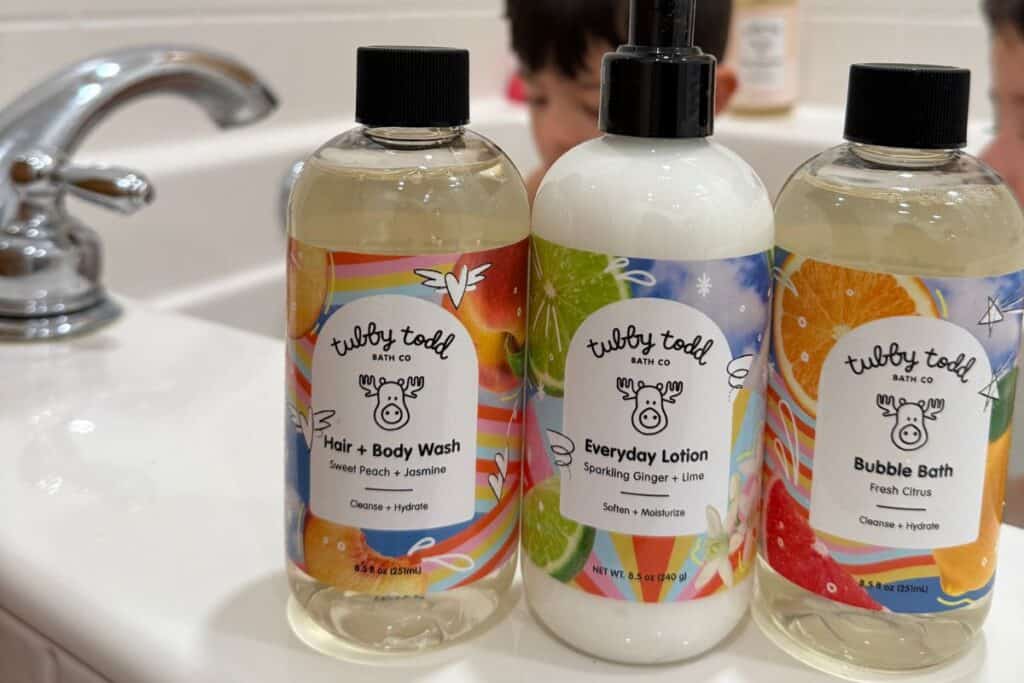
I saw this as a mom who’s second baby had a TON of skin sensitivities to products, please be easy on yourself if you’re navigating the same. No, you’re not a bad mom. No, you’re not harming your child. You’re trying to find the right solution for them and sometimes it takes time (and a lot of conversations with your pediatrician) to find the best solution.
What to Look For
- Fragrance-free or naturally scented
- Short, simple ingredient lists
- Hypoallergenic formulas
- Preservatives like sodium benzoate instead of parabens
Product Recommendations
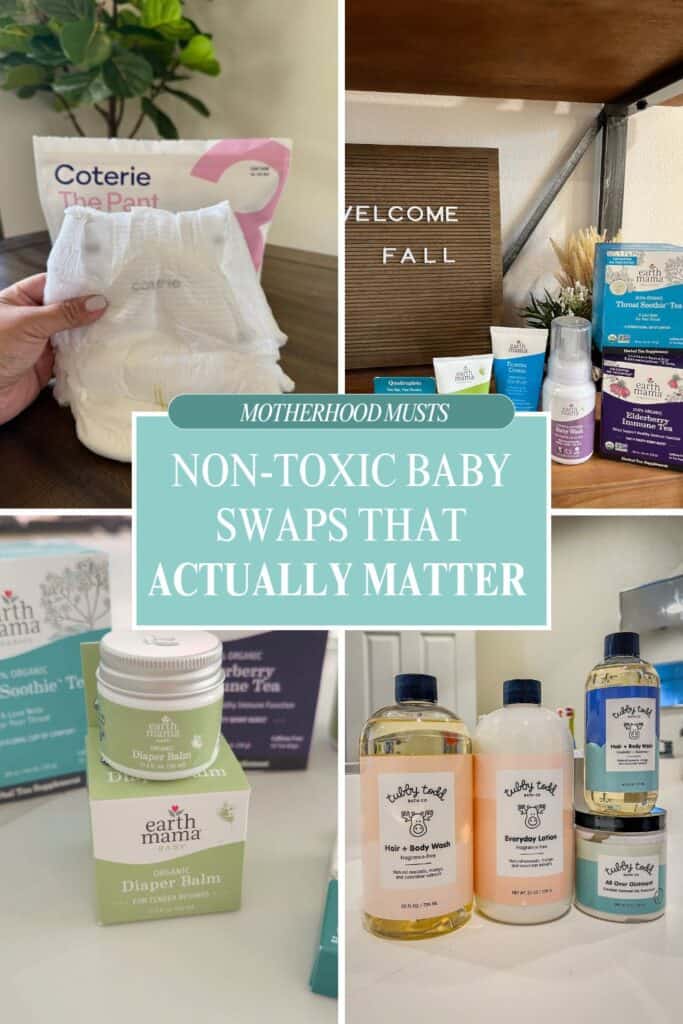
- Tubby Todd Hair & Body Wash — gentle, clean ingredients, excellent for sensitive skin.
- CeraVe Baby Wash & Shampoo — affordable, fragrance-free, recommended by dermatologists.
- Earth Mama Calming Lavender Baby Wash — herbal, plant-based, and well-tolerated for many babies.
Feeding Products (Bottles, Cups, Plates, Utensils)
Feeding items are worth considering a switch because anything that touches your baby’s milk or food has a higher exposure pathway. Remember, start small. If you’re looking to replace your baby’s feeding products, here’s what we suggest.
What to Look For
- Glass or stainless steel bottles
- 100% food-grade silicone nipples & cups
- Stainless steel or silicone dishware
- Avoid heating food in plastic containers
Product Recommendations
- Comotomo Bottles — soft silicone, minimal parts, great for picky babies.
- Dr. Brown’s Natural Flow (Glass) — excellent for reducing gas/reflux, BPA-free.
- Pura Stainless Steel Bottles — plastic-free, long-lasting.
- EZPZ Silicone Plates & Bowls — suction plates that stick well and are 100% food-grade silicone.
Diapering Products (Wipes, Creams, Diapers)
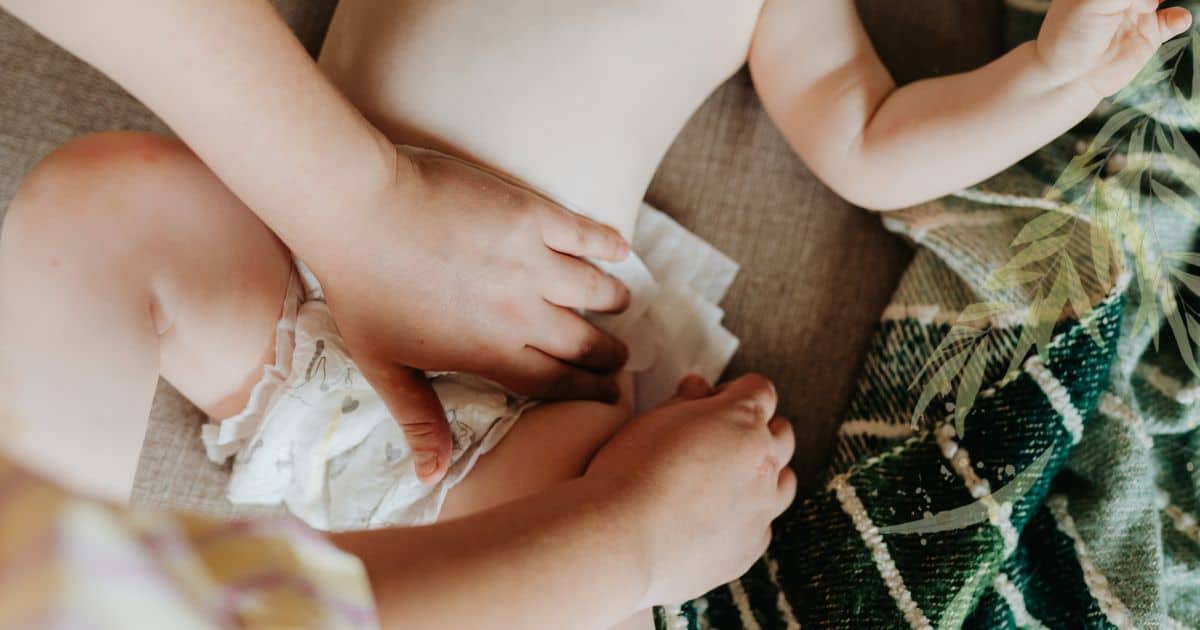
Since diapering involves prolonged skin contact for your little one, gentle formulas can really help reduce irritation to their body and skin.
What to Look For
- Fragrance-free wipes
- Simple barrier creams
- Chlorine-free or low-chemical diapers (if your budget allows)
Product Recommendations
- Water Wipes — 99.9% water, extremely gentle, our absolute FAVORITE baby wipes.
- Pampers Pure — an affordable and cleaner option from the mainstream brand, widely available.
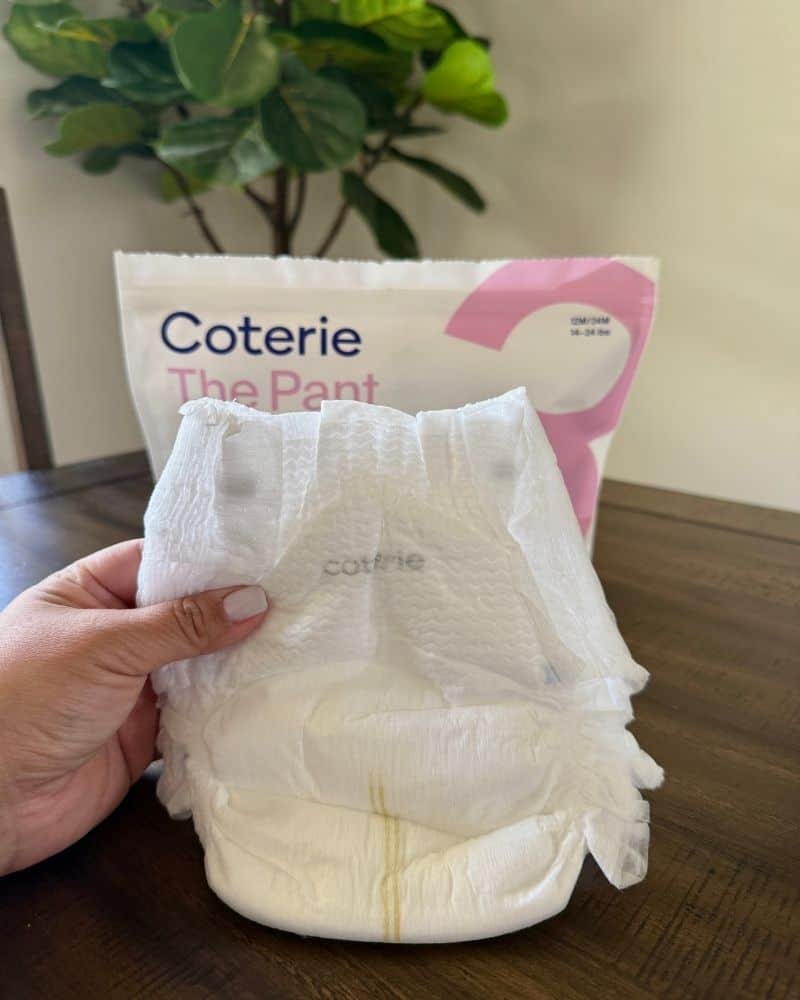
- Coterie Diapers & Wipes — fragrance-free, chlorine-free, excellent absorption.
- Boudreaux’s Butt Paste (Maximum Strength) — no parabens, very effective for diaper rash.
- EcoPea Bamboo Diapers — an eco-friendly, hypoallergenic option using a natural absorbent bamboo pulp. EWG certified and is a USDA Certified Biobased Product.
- Earth Mama Organic Diaper Balm — herbal, soothing, and EWG Verified.
Crib Mattress & Sleep Essentials
Babies will spend more time sleeping than anything else they do, making this one of the highest-impact categories. GREENGUARD Gold certification ensures low chemical emissions and fewer VOCs, so keep a look out for that certification when shopping for a baby or toddler mattress.
What to Look For
- GREENGUARD Gold–certified mattresses
- Organic cotton or wool fabric/covers
- No added flame retardants
- Breathable materials (bonus)
Product Recommendations
- Newton Baby Crib Mattress — breathable, GREENGUARD Gold certified.
- Naturepedic Organic Crib Mattress — 100% organic materials, no flame retardants, MADE SAFE certified.
- Avocado Organic Crib Mattress — natural materials, GOTS-certified.
- Burt’s Bees Organic Cotton Sheets — budget-friendly and OEKO-TEX certified.
Toys & Teethers
Since it’s inevitable your baby will put everything in their mouth from toys and teethers, choosing to have some made from safer materials can minimize exposure to harmful chemicals.
What to Look For
- 100% food-grade silicone
- Natural rubber
- BPA-free, phthalate-free plastics
- Avoid vinyl/PVC when possible
Product Recommendations
- Sophie La Girafe (natural rubber teether) — a classic, widely loved teether that uses food-grade paints, and is BPA, PVC and phthalate free.
- Mushie Teething Rings — soft 100% food-grade silicone, easy for tiny hands to grasp.
- Lovevery Play Kits — Montessori-inspired, sustainably made toys with safe materials.
Laundry Detergent
Well, we know that baby skin is more sensitivie than ours, and unfortunately, it’s not uncommon for laundry detergent residue to cause irritation or eczema flare-ups.
What to Look For
- Fragrance-free
- Dye-free
- Gentle surfactants
- No optical brighteners
Product Recommendations
- Tide Free & Gentle — dermatologist recommended, gentle enough while maintaining excellent cleaning power.
- All Free Clear — 100% free of perfumes and dyes, budget-friendly, gentle on baby skin and uses biodegradable surfactants.
- Seventh Generation Free & Clear — plant-based, fragrance-free.
- Molly’s Suds Baby Detergent — clean ingredients and gentle on sensitive skin.
If you try to focus on just one or two categories first, for instance, feeding items, mattresses, or daily skin care, you’re already making meaningful progress. You don’t have to overhaul your entire home overnight.
Non-toxic living shouldn’t be about demonizing every ingredient to a point where you’re terrified to take your baby out of the house. It should be about reducing exposure where it matters most, not living in fear or perfection.
Frequently Asked Questions About Non-Toxic Baby Products
Do I need to switch all my baby products to non-toxic options?
Not at all. You do not need a perfectly non-toxic home to raise a healthy baby. Health organizations like the American Academy of Pediatrics emphasize reducing exposure where it’s practical, not eliminating everything at once. Your biggest wins come from choosing safer options in the categories your baby uses the most: feeding products, skin care, and the sleep environment.
Is fragrance really that bad for babies?
Synthetic fragrance blends can contain allergens and irritants, which is why the AAP recommends minimizing fragrance for infants when possible. That doesn’t mean every scented product is dangerous, but fragrance-free options may reduce the risk of skin irritation, eczema flare-ups, and respiratory sensitivity.
Should I avoid plastic altogether?
You don’t need to ban and remove all plastic from your home, but it is smart to avoid heating it. Research shows plastics are more likely to leak chemicals when microwaved or exposed to high heat. Using glass for warming bottles or stinless steel for storing hot foods is an easy, inexpensive improvement.
Is it worth buying an organic crib mattress?
If the budget allows, a GREENGUARD Gold–certified or organic mattress is a worth-it swap because babies sleep so many hours a day. But if not, don’t stress.
Using breathable bedding, washing new items before use, and ventilating the nursery can also help reduce VOC exposure. Using an air purifier is also another great parenting hack not talked about often enough.
Aliright, so if you’re walking away from this guide feeling a little lighter, that’s exactly what I hoped for. Choosing non-toxic baby products shouldn’t feel like an impossible standard or a race to perfection. It’s simply about making thoughtful swaps and giving yourself permission to let the rest go.
So whether you swap your baby’s lotion, upgrade the bottle you warm milk in, or simply stop microwaving plastic—you are already doing an incredible job. You’re paying attention. You’re learning. You’re choosing balance instead of fear. And that will always be enough.
If you ever start to feel overwhelmed, come back to this guide and remind yourself: Progress matters. Perfection doesn’t.