

Chinese Gender Predictor Calendar: How It Works (And How to Use It Right)
This post may contain affiliate links that I may receive a commission from if you click & buy. In addition, the information on this site is NOT intended to be medical advice. See my full policy for more information.
Finding out you’re pregnant is one of the most wonderful, exciting, and scary moments. Maybe you’d been wondering for weeks. Perhaps it’s been a journey and a half to get there. Either way, after you find out, another burning question might pop up: Will it be a boy or a girl? (Cue the Chinese gender predictor calendar.)
While any healthy baby is undeniably a good thing, it’s also completely normal to wonder what the future will hold. I remember pondering this same question many times during both my pregnancies. I just wanted any information I could get about this new human entering our lives.
But the anatomy scan can feel light-years away. This is why many moms (including me!) turn to the Chinese gender predictor calendar. It’s been around for centuries, and millions of moms-to-be try it every year. No, it’s not science. But it’s something you can have a bit of fun with while you wait to actually find out. Below, I’ll walk you through how it works, how to calculate your lunar age (the step most people get wrong), how to read the chart, and what the research says about accuracy.
Disclaimer: This article may contain commission, paid partnerships, or affiliate links. We independently review everything we recommend. When you buy through our links, we may earn a commission from qualifying purchases.
What Is the Chinese Gender Predictor Calendar?
The Chinese gender predictor calendar (also called the Chinese gender chart) is a simple grid that claims to predict whether you’re having a boy or a girl. It uses just two things: your age and the month you conceived.
Legend has it that the original chart was discovered in a royal tomb near Beijing hundreds of years ago, and that the imperial family used it to predict the sex of future heirs. Is this story 100% true? Debatable, and it may depend on who you ask. But, like many legends, that’s part of its charm.
One thing that is real is that the chart is based on the Chinese lunar calendar, which follows the cycles of the moon (with adjustments to keep pace with the sun). This is why the chart calls for your lunar age, not your regular age. (We’ll get there soon, I promise!)
How Does the Chinese Gender Predictor Work?
It might sound complicated, but the Chinese gender predictor is super simple. It only needs two pieces of information:
- Your lunar age at the time of conception
- The month you conceived (not your due date or baby’s birth month)
Once you have both, you find where they meet on the chart, and boom, there’s your prediction. Let’s break down each step.
What Is Lunar Age? And How Do You Calculate Yours?
In traditional Chinese age counting, you’re considered 1 year old the day you’re born. And instead of getting a year older on your birthday, everyone gets a year older on Chinese New Year. This means your lunar age is usually one or two years older than the age you normally use. This is the lunar age gender predictor step where most people slip up, so let’s go slowly:
- Take the year you conceived and subtract the year you were born.
- Add 1.
- If you conceived before Chinese New Year that year, subtract 1.
- If you were born before Chinese New Year in your birth year (usually January or early February), add 1.
Keep in mind that Chinese New Year moves every year and usually falls between late January and mid-February, so look up the exact date for both your birth year and your conception year.
Here’s an example: Meet Julie. She was born on August 12, 1996, and she conceived in April 2026.
- 2026 − 1996 = 30
- 30 + 1 = 31
- She conceived in April, which is after Chinese New Year 2026, so no change.
- She was born in August, which is after Chinese New Year 1996, so no change.
Julie’s lunar age at conception is 31, even though she was only 29 when she conceived. Confusing, right? But this is how you do it.
How to Find Your Conception Month
Unless you were tracking closely, you probably don’t know the exact day you conceived, and that’s totally okay! You just need a close estimate of the month.
- If you know your due date: Count back about 38 weeks. This lands you right around conception.
- If you tracked ovulation: Use your ovulation date. Conception usually happens within a day or so of it.
- If you conceived through IVF or IUI: You have the most exact date of anyone! Your clinic can confirm it if you’re not sure.
If your math falls right on the edge of two months, try both and see what the chart says (it’s all for fun anyway!). One more thing: traditional versions of the chart use the lunar month of conception, while most charts you’ll find online simply use regular calendar months. Either way, just be consistent with the chart you’re using.
The Chinese Gender Predictor Chart
Here it is, mama, the moment you’ve been scrolling for.
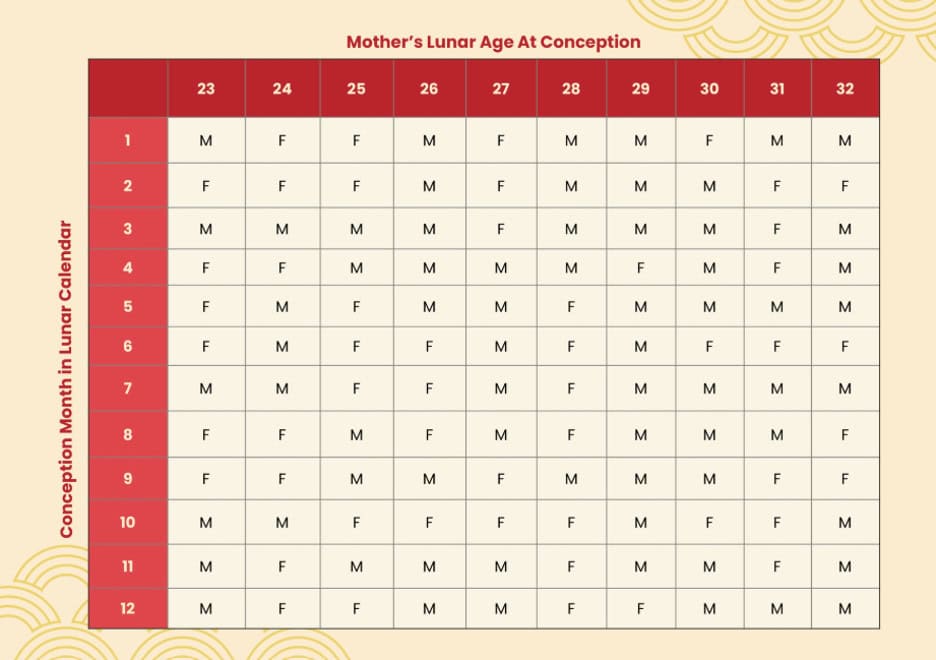
At first glance, it looks like a big grid of letters, but I promise it’s easier than it looks:
- Down the left side, you’ll find the mother’s lunar age at conception (usually from 18 to 45).
- Across the top, you’ll see the 12 months of conception, January through December.
- Inside each box is either a B for boy or a G for girl.
To get your result, find your lunar age in the left column and slide your finger across that row until you hit your conception month. The letter in that box is your Chinese birth chart boy or girl prediction. No complicated math, no special app. Just your two numbers and a little bit of anticipation.
A quick note: You might notice that different websites show slightly different versions of the chart. It has been copied, translated, and reprinted so many times over the years that small variations have crept in. If you try two charts and get two different answers, don’t panic. (Consider it the chart’s way of reminding you this is all for fun!)
How to Use the Chart: Step-by-Step
- Calculate your lunar age at conception. Conception year minus birth year, plus 1, then adjust for Chinese New Year.
- Find your conception month. Count back about 38 weeks from your due date, or use your ovulation or IVF date.
- Find where they meet on the chart. Locate your lunar age on the left side, then follow that row across to your conception month.
- Check your letter. A B means the chart predicts a boy, and a G means it predicts a girl.
Don’t forget to screenshot your result. You can pull it back out after your anatomy scan (or on delivery day!) to see if the Chinese gender predictor calendar got it right. It’s a fun one to add to your pregnancy keepsakes, too.
How Accurate Is the Chinese Gender Predictor?
When it comes down to it, Chinese gender calendar accuracy is almost the same as flipping a coin. You’ve got a 50-50 shot.
In 2010, a team of researchers put the chart to the test in a big way. They checked it against nearly 3 million births in Sweden, figuring out each mom’s lunar age and conception month and comparing the chart’s prediction to the baby’s actual sex. The chart was right about half the time, which is about as accurate as guessing. In other words, maybe don’t pick nursery paint colors based on it. (Fair.)
And this really makes sense. Your baby’s sex is set at conception, depending on whether the sperm carries an X or a Y chromosome. Your age and the month on the calendar don’t change that.
Now, if the chart nailed it for you, your sister, and your best friend, you’re not imagining things. With only two possible answers, the chart is going to be right for roughly half of everyone who tries it. For our family, it was right for one of our two boys.
So why try it at all? Because it’s fun! Pregnancy involves a lot of waiting, and a little lighthearted guessing can make that wait feel more exciting. It’s a sweet way to connect with a centuries-old tradition, involve your partner, or start a friendly family bet.
Just don’t depend on it for real-life decisions. If you want to actually know whether you’re having a boy or a girl, talk to your provider. A prenatal blood test (NIPT) can often reveal your baby’s sex as early as about 10 weeks, and your anatomy ultrasound (usually around 18 to 22 weeks, during the second trimester can often tell too, as long as your baby is in a cooperative position.
Chinese Gender Predictor: Boy or Girl? What Other Moms Say

Ask any group of moms about the Chinese gender chart, and almost every one of them will have a story. These are the kinds of stories that come up again and again in Reddit threads and Facebook groups, and yes, the results are a little all over the place.
Some moms swear by it. A few moms say it was right for all three of their kids. One used the chart before getting pregnant with her last baby, hoping for a boy, and she got her boy. Another said it was right for both of her kids, then laughed that it had a 50/50 shot anyway.
Others? Not so much. One mom tried about 50 old wives’ tales, and most of them said girl. It was a boy! Another said every single prediction tool pointed to boy, and she ended up with a girl. One mom got a “girl” prediction for both pregnancies, and she has one son and one daughter.
And one mom made a point that’s hard to argue with: if the chart really worked, boy/girl twins couldn’t exist.
Whether the chart turns out to be spot-on or hilariously wrong, it definitely gives you a story to tell. And one day, you’ll get to share yours with your little one too.
Other Fun Ways to Predict Your Baby’s Gender
If you’re still in guessing mode, here are a few other popular ways moms try to predict whether it’s a boy or a girl. (Same rules apply: all fun, no science.)
- The Ramzi theory: This one is based on where your placenta is forming on an early ultrasound. The idea is that a placenta on the right side means boy and one on the left means girl. It’s hugely popular in online pregnancy groups, but it hasn’t been backed up by solid research.
- The ring test: A classic baby shower game. You dangle a ring on a string or a strand of hair over your belly or wrist and watch how it moves. A circle supposedly means girl, and a back-and-forth swing means boy.
- The heart rate myth: A heartbeat over 140 beats per minute supposedly means girl, and under 140 means boy. It’s one you’ll hear a lot from well-meaning relatives, but research hasn’t found a real difference in heart rates between boys and girls in early pregnancy.
- Morning sickness: Legend says that if you’re sicker than a dog, you’re having a girl. Interestingly, some research has found that very severe morning sickness is slightly more common in pregnancies with girls. But plenty of moms have been miserable with boys and felt great with girls, so it’s definitely not a reliable predictor.
Curious about more old wives’ tales? Check out my guide to Signs You’re Having a Boy [EDITOR: link when published, January 2027] for even more fun theories to try.
Frequently Asked Questions
At the end of the day, whether the chart says boy or girl, the best part is the little life you’re growing. Have fun with the guessing, mama, and enjoy every bit of the anticipation. You’re doing amazing. Tell us in the comments what the chart predicted for you!